Style Q+A: Moore & Giles

Editor’s note: To catch up on other Style Q+A entries, click here.

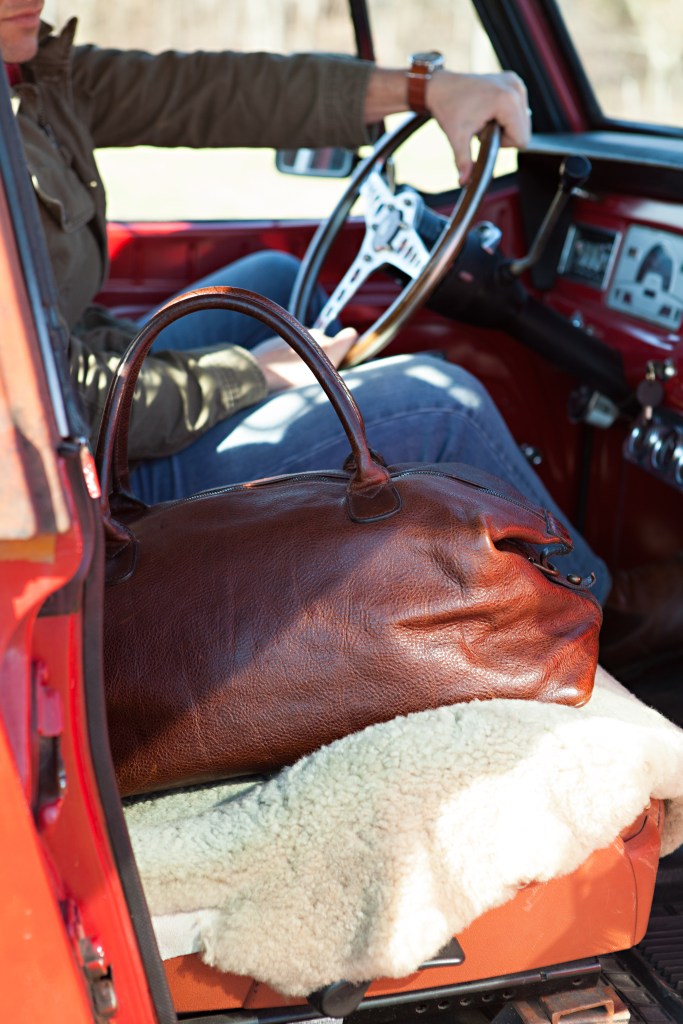
Built for the road ahead -- it was great to catch up with team at Moore & Giles (makers of the Benedict Weekend Bag) seen here.

Built for the road ahead — it was great to catch up with team at Moore & Giles (makers of the Benedict Weekend Bag) seen here. Photo courtesy of the brand.

Whenever I get the chance to stop by various #menswear events happening around NYC or around the country, I’m always intrigued and curious to see who I might meet, or what brands I might discover. At this past December’s Pop-Up Flea in New York City (a cornucopia of great lifestyle and men’s goods brands all in one spot), it was hard not to discover the stunning leather goods on display at Moore & Giles. I got to chatting with the brand’s Director of Marketing, Daryl Calfee, about some of the stellar product the brand had brought (seriously, it was museum-worthy). He just happens to be good friends with my pals over at Brothers & Craft, so we naturally hit it off talking all things men’s style. I also got to know the brand a bit more, and it’s a worthwhile one to know. In addition to a massive collection of fine leathers,  they also produce their own line of jaw-dropping bags, renowned for their heritage quality and style (in fact, I covered the Benedict Weekend Bag for GearMoose). Throw in a well-curated, stellar assortment of home goods, and you’ve got enough gear to make your head spin (the 33 Chair in particular is Wish List-worthy).

Given the brand’s affinity for quality and nuanced design, it was great to be able to send over a few questions to Thomas Brennan, the brand’s Director of Design for Bags & Accessories. After you get a look into the Moore & Giles process, you very well might want a bag for yourself. Enjoy this one, folks!

(Editor’s note: In the meantime, got a brand or style personality you’d like to see answer some zingers?Let me know via Facebook or Twitter).

The Style Guide: Take me through the background of Moore & Giles and how you approach your work?

Moore and Giles:  The brand was founded in 1933 as a materials supplier to local shoe manufacturers. Donald Graeme Moore traveled around the area sourcing and selling everything from shoelaces and eyelets to nails and leather. Eventually his offerings narrowed to strictly leather   and his regional hunt gradually expanded into the global quest it is today to uncover hidden gems at tanneries in all corners of the world. The company develops, sources and sells millions of square feet of leather a year across a variety of industries including furniture manufacturers, private aviation companies, and high-end homes and hotels.
The bag division developed in 2007 when our president and vice president decided to take advantage of their access to such magnificent material and made a few travel and work bags to bring with them on their travels. The line has grown organically from that point into the extensive, well curated line of bags and accessories that exists today.
Our products are unapologetically traditional. Artisans have been tanning hides for millennia and hand-sewing the resulting leather into useful objects for just as long. Both the material history and the history of our own company add welcome layers of authority, grandeur, and natural beauty to our bags; my job is to simply accentuate the existing beauty of the material with understated designs that will age as well as the leather.
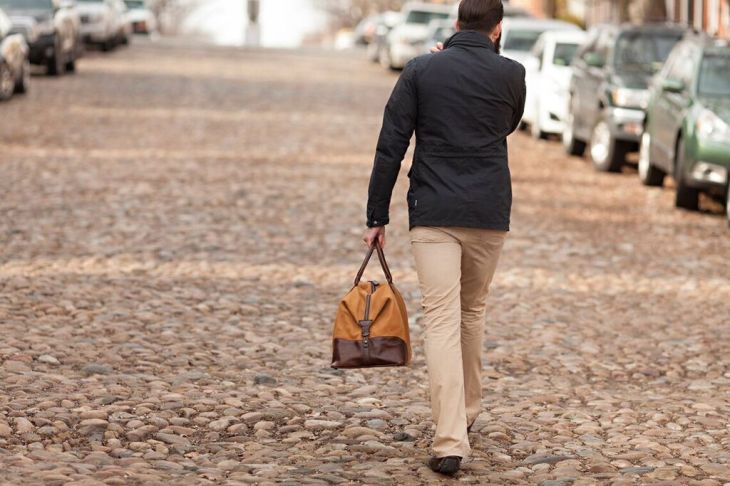
Just one of the exceptionally high-quality bags produced by the brand. Photo courtesy of Moore & Giles.

Just one of the exceptionally high-quality bags produced by the brand. Photo courtesy of Moore & Giles.

TSG:Where do you find your biggest sources of inspiration?
M&G: The leather itself is the primary inspiration. We are fortunate to have close relationships with a 150-year old tannery in Italy, which means that our “product development” begins with prototyping leather colors and experimenting with different finishes, various combinations of waxes and oils, milling times, and ironing treatments. These design decisions affect the finished product long before I ever sit down to sketch a specific silhouette. When I do sit down to design a bag, I tend towards clean exteriors, traditional shapes, discrete details——decisions that keep the natural beauty of the leather front and center.
 Reading books, talking with creative peers, and sifting through vintage stores all provide great creative fodder but for the ultimate design inspiration, nothing beats close observation of day-to-day routines. Take going on a business trip, for instance. As I’m packing, I want to make the job easier, tidier, more secure and I want my shoes kept separate from my shirts; when I’m going through airport security I need a convenient, safe spot to tuck my wallet and cell phone; when I’m putting my bag in the overhead bin I want easy access to my notebook or a magazine but don’t want to rifle through the body of the bag; if I’m meeting with a new manufacturer I want to have my business cards close at hand. I aspire to be more organized than I am and more put together than I often feel. Our bags help me on both fronts.


TSG: What, in your mind, can a great leather accessory do for a guy who might not have given it much thought before?

 M&G: In a lot of ways, having a great leather accessory is like be the owner of the easiest pet ever: It will never cease to amaze you how happy you get when you see it; you’re going to feel more fond of it the longer you have it; strangers will stop you and ask you about it. Added bonus: you don’t have to feed it and it arrives at your door already housebroken.
TSG: Are there new product categories that you want to expand into in the coming seasons?
M&G: What’s proving more interesting than expanding out across new categories is finding new ways to give the existing line more depth and texture. The sheer volume of colors and finishes of leather we have at our fingertips is dizzying. The collection of artisans who tan, stamp, hand-stain, carve, and etch, to whom we have access is incredibly deep. Eight years in, we’ve only scratched the surface of what the bags and accessories can look like. As an example: we introduced a bespoke program during the holiday season last year that has given our customers a chance to participate in the creative process by selecting from a more expansive palette of hides to use on a custom travel or work bag. Seeing the colors that customers gravitated towards——reds and purples and golden tans and cool grays——and the types of leathers they’ve responded to———leathers that are exceptionally rare, have more history, or age in unique ways——informed several recent releases (like our Modern Saddle collection featuring vegetable tanned leather) and inspired a roster of upcoming releases.
TSG: What’s one thing every guy should have in his closet in terms of style?
M&G: Wherever you sit along the style continuum between a tailored suit and leather lace-ups and raw denim and sneakers, our classic Benedict Weekend Bag is a worthy compliment. It’s simple, beautiful, and functional. Unlike some other sartorial decisions, I guarantee you’ll still be proud of yourself for owning one ten years from now.
To keep up with all things Moore & Giles, follow the brand on Instagram or via Twitter.

Shop the latest in Men's styles Under $50 + get FREE Shipping on orders over $100 at Frank & Oak!

Style Q+A: Theo and Harris Vintage Watches

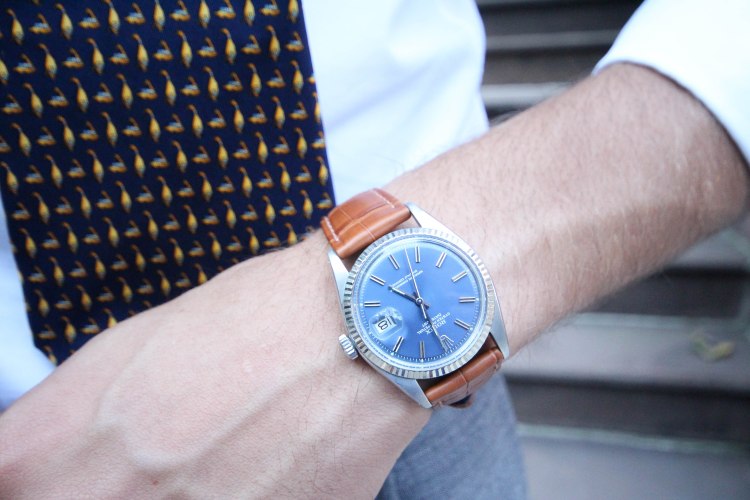
A Rolex Datejust is just one of the many terrific vintage options on rotation from Theo & Harris. Photo courtesy of the brand.

A Rolex Datejust is just one of the many terrific vintage options on rotation from Theo & Harris. Photo courtesy of the brand.

Editor’s note: For more Style Q&A entries featuring everyone from Megan Collins of Style Girlfriend to Barron Cuadro of Effortless Gent, click here.
If you read this blog, you know I have a passion for watches.  While I have a list of “holy grail” watches I hope to own one day (a Shinola Runwell and an Omega Seamaster among them), I also appreciate simple, uncluttered, solid everyday watches. That means timepieces like an Invicta Pro Diver , which I’m wearing as I write this post, and a great leather dress watch from Daniel Wellington. But there’s a certain breed of watches that up until earlier this year, I wasn’t too familiar with — vintage timepieces.

Join the Hunt Club - Enjoy FREE Shipping, Cashback + more at Frank & Oak! Try it now for 90 days, risk free!

My friend Christian Zeron, co-founder of start-up vintage watch collector Theo and Harris, first brought his fresh-out-of-the-gates company to my attention earlier this year. I covered them for VOUCH Mag this past summer, and here’s where it gets interesting — Theo & Harris sources, authenticates and sells all manner of vintage mechanical wristwatches, offering a plethora of coveted and rare timepieces along the way (seriously, prepare to be amazed by the company’s archive). That they’ve built such an archive since launching in February of this year is quite impressive, to say the least. Specifically, we’re looking at 200 watches (and counting) sold to 10 different countries in about 9 months, and their current collection is only growing. And if you want to experience even more watch envy, check out the Theo and Harris Instagram. Vintage watches are, of course, expensive by nature. And if you’re fortunate enough to own a vintage watch as a family heirloom, that’s a special story that only you have. However, there is an argument for investing in a beautiful vintage watch. So while you mull on that (and perhaps peruse the Theo and Harris site), I do hope you peel your eyes away long enough to read what Christian had to say on his interest in vintage watches and most importantly, why you (yes, you) should own a vintage watch. Again, I’ll only stick around to ask the questions.
The Style Guide: Tell me about how you got into vintage watch collecting?
Theo & Harris: Initially, my interest in watches was purely aesthetic. I was, and still am, very into watches that have a unique look and style; but as the interest became an addiction I began studying history, mechanics and technical design- being an enthusiast is a full time job on its own. I never owned many watches for myself though. Actually, the only watch I consider mine is the first one I ever bought — a Rolex Datejust reference 1601 with a brilliant blue dial.
TSG: During your time scouting out vintage timepieces, what have you noticed that separates these watches from their modern-day counterparts?
T&H: Value. There are some makers out there … that turn out some tremendously well-valued watches comparable to their equally priced counterparts. However, as a whole, modern watches are built in factories, by machine and without heart and then become, for some reason, painfully expensive. In vintage, I work everyday with watches under $800 that were designed by industry legends, assembled by hand and made to last.
Vintage watches go well with all sorts of outfits if you pick the right timepiece, according to the brand.

Vintage watches go well with all sorts of outfits if you pick the right timepiece, according to the brand.

TSG: How can a vintage watch set one apart stylistically?
T&H: The whole point of developing a style is to most accurately depict yourself through colors, textures, patterns (and) fits. With a modern watch shop selling only 5 brands, maybe  50 watches total, it’s impossible for everyone to actually be choosing what they want.
If 1,000 people are wearing the same 50 watches, they’re settling. Imagine if the whole world had to pick from 50 T-shirts to wear.
In vintage, you’re dealing with hundreds of brands and over 100 years of production. I can guarantee that there is, somewhere out there, the perfect watch for everyone. Luckily, finding them is my job.
TSG: What’s one vintage watch brand those looking to get into the vintage watch game should look for, if any?
T&H: Omega. Don’t get me wrong, there are dozens of other makers that I couldn’t live without but Omega is, at least to me, king. Foremost, they were all built with great attention to detail and obvious care. The movements are absolutely beautiful to look at and rather easy to service when needed. As far as design, Omega has drawn up some of the most classic watches ever to hit the wrist. Lastly, their product line is so incredibly vast that it caters to suits, soccer fields, boardrooms and the moon.

A vintage watch can work in many of the same situations as a regular timepiece -- just don't be afraid to rock. Photo courtesy of Theo & Harris.

A vintage watch can work in many of the same situations as a regular timepiece — just don’t be afraid to rock. Photo courtesy of Theo & Harris.

TSG: What are the qualities or characteristics that set apart a really “good” vintage watch, or at least one that’s still in good shape?
T&H: First, I work with, and wear, vintage watches all day of every day and my taste, although acknowledges, doesn’t prefer “good” from “fair” condition across the board. If I’m looking for a military watch from the Vietnam War, I want one that looks like it’s been beaten to hell. Every detail of wear, every nick or scuff is a piece of an inconceivably long story of this time traveler’s life. However, on all watches, the important elements to look out for are an unpolished or lightly polished case, a clean and properly functioning movement and an original dial. Those characteristics are always important, regardless of the style or period of the watch you’re looking at.
TSG: What are some ways to make sure you’re getting a fairly priced, authentic timepiece?
T&H: Remember, with watches comes more than 100 years of history, design, mechanics and an evil industry profiting off of the replication of all of it. Sure, anyone can try their hand at this tricky slope but to really be able to discern for yourself, there’s a whole lot of studying ahead. If that’s you’re thing, then you’ll never stop reading and loving every second of it. The reality, however, is that not everyone wants to be a full-time expert in everything they enjoy. For those people, they’ll have to find someone they can trust. A shop that’ll do all of the sourcing and sifting for them, a shop that will take all of the risk.
TSG: What’s one thing you’ve learned since getting into the watch business that people might  not expect?
T&H: In the past seven months I’ve learned, more than anything else, how to listen ever so carefully to my audience. For example, since we’ve started, we’ve redesigned our website from head to toe three separate times and we don’t go a week without minor alterations. That’s not to say I didn’t love each iteration of our virtual home base but I’ve learned how to read customer feedback, whether thats an email or a huge analytic, and tailor our services accordingly. With our website design, it not only has to be pleasing to view but also interactive to the point that it dynamically presents each of our products to our viewers just as well as I could in person over a drink. Getting into this, I really thought it would be 100% about our watches but with time, I’ve come to realize that, besides our excellent collection, there needs to be an equal experience.
What are your thoughts on vintage watches? Have you ever considered owning one, or do you own one already? What’s the story behind it?
As always folks — thanks for reading and stay stylish,
-Beau

Shop the latest in Men's styles Under $50 + get FREE Shipping on orders over $100 at Frank & Oak!